Sunday, 27 November 2016
Smashing Gauntlets
Sandra Jensen reads hate to the Alberta Legislature
Sandra Jensen is pounded by misogynistic insults because she crosses the floor of the Alberta legislature to join the NDP. She reads the insults aloud in the house and her male colleagues sit in silence, some of them stunned, some of them nodding and perhaps, some of them, wishing they had said it. If any of them has been a teacher, he or she has heard it before.
In secondary schools, female teachers can wade through this type of behavior, this culture of hate, for long periods of time. Like Sandra Jensen, the hate springs from the constituency they serve. Fortunately Ms. Jensen does not have to spend day after day with it but female secondary teachers can end up swimming in it for long periods of time.
Now, some of my colleagues may like to deny this behaviour exists and to be perfectly candid, currently at my school, I think we have managed to stamp it out for now, but I have seen it rear its head on several occasions and it will do so again. The behavior first appears as a gauntlet. Young men line either side of the hall, leaning against the lockers and they use this gauntlet to rate female students, harass what they perceive to be weaker males and attempt to intimidate teachers. Their language is foul, their behaviour, boorish. It is like a pack trying to mark its territory .
In good schools the teachers own the halls. Good teachers know the school. They move through all parts of it. They take different paths to their classrooms and they go out of their way to find students who look like they might be alone. They are in the halls between classes, before school, after school and they walk them with their ears and eyes wide open. They make eye contact with everyone, they call students by name as they move.
Good administrators walk the halls too. They know their students, they know their teachers. They visit all the areas of the school, starting with a daily and unannounced visit to the darker places: the smoking pits, the areas outside bathrooms and locker rooms. When a teacher reports an incident in a hallway, the good administrator knows that, in this case, there is no student side of the incident.
Let's learn the lesson of Jordan Manners
For the most part, the society recognizes the work teachers do in classrooms but it rarely recognizes the work in halls and cafeterias and gymnasiums. Society expects and gets the delivery of curriculum but the truth is, it is the socialization of young adults that is the essential work of schools. A good school spends as much time developing an environment of fairness, equality, empathy and compassion as it does in the delivery of curriculum. It demands that every person in the building behave in a manner that is respectful and polite. It makes these demands in a myriad of ways.
Confronting kids in a hallway is not for the faint of heart: "You take off your hat in a public place." "You make eye contact when I speak to you." "Stand up straight." "You address me as sir." "Move along." "Are you alright?" "Get to class."
This is the essential work that the critics of our system and the critics of teachers never acknowledge goes on. The "can't do, teach" crowd never recognizes the subtlety, the consistency, the strength of will and the determination that is required to foster the values of compassion, empathy, and equality in young people. My hunch is that they never recognize this work because they miss the gauntlets they formed in high schools in the "good old days."
When female legislators are attacked, when female reporters are harassed at sporting matches, when rudeness goes unchallenged on streetcars, teachers recognize the behaviour. We've seen it before, we try to stamp it out and when we see it manifest itself in these places, we recognize we have more work to do.
Sunday, 20 November 2016
A Literary Dog Walk
Come on girls, let's go. Just let me get your leashes on. Yes, it's a little cold tonight but we've got to do it. Let's go. Let's just turn out of the driveway here and head down the street. Who knows how far we will go and who we will meet tonight.
Ya I know, the couch was more comfy. Ok, just have a sniff there.
Hey, there's Bob Ewell, the red neck cracker in To Kill a Mockingbird. Seems appropriate that he would join us on the walk tonight. It's right around now, after the American Thanksgiving and the Harvest Pageant, when he attacks Scout and then breaks Gem's arm. Scout is dressed like a ham and cannot see the attack.
So glad Bob's here. He's a first class bigot and a second class white trash citizen in Maycomb County. Remember how he seeks to satiate his anger at being white and poor in the deep south by accusing a black man, Tom Robinson, of raping his daughter Mayella? He blames "the other" for his problems and a large portion of the town points the finger right along with him. No worries about you becoming dated Bob, you're alive and well and living in all the places where blaming others for your own circumstance is now known as "populism."
Come on girls, let's keep moving.
I hate Bob Ewell. Well, sometimes I hate him. Somehow it's not an open and shut case with him. It's like when Walter Cunningham comes to lunch with Scout and she's amazed that the kid puts syrup on his lunch. Atticus tells Scout not to judge. Walk a mile in his shoes Scout. Somehow I end up feeling for the Ewells. Even Mayella. She's just lonely and invites Tom Robinson in to talk. Good Ol' Bob here, beats on her. How the hell is it possible for me to feel empathy for that red neck cracker?
The dogs are leading me home but I am not with them. I am in Maycomb Georgia with Scout and Gem, Atticus and Boo, Mayella and Tom. Bob Ewell started it all by emerging out of the darkness into my imagination on that first turn of our walk on this dark November night.
We all carry our work days home with us. Bosses and clients and issues and budgets and deadlines cloud our minds after dinner, while we watch TV or take our kids to hockey. I've certainly lugged a few troubling classes along with me on the nightly dog walk but I have been luckier than a lot of people. I've spent my life carrying around characters, talking about fictions.
I've spent a large part of each working day living in fiction...and that...that has made all the...never mind.
Let's go in. Let's get in the house...As For Me and My House...
Sunday, 13 November 2016
Reflections on an Election

Was it a sunny day after Trump's election?
I know it was like waking from a bad dream and then having that realization "my God, that really happened." My head is filled with questions. How is it possible that Trump won? How can a unqualified man defeat a qualified woman? How is it possible that the things I value, the things I teach, critical thought, rational argumentation, kindness, compassion, tolerance, have all been overthrown by those who believe in a piece of rhetoric so ridiculous as Make America Great Again?
There's fear too. You just wonder how far this type of demagoguery can go, will go. You don't need too fertile an imagination to envision mass deportations, the arrest of political opponents and the intimidation of the free press, to make you run and want to hide your children.
My mind spins towards darkness, it struggles to find light. Then I read the Facebook posts of young people I have known through teaching and coaching:
From Nancy Tombe: "Feeling so very disgusted and so very disappointed by America this morning. I'm also so very sad for those of you that didn't choose hate, and now must live with the repercussions of those that did.
This from Tori Allen about Kellie Leitch, the hateful Tory leadership candidate who espouses many of Trump's ideas: "Canada, shut this down now. And by shut down, I mean take it seriously, figure out who this appeals to, why and how to bridge that divide before it turns into a chasm."
This from Joanna Kyriazis: "I know many of us want to turn to fear and blame. But those are the attitudes and approaches that led us to these results. We need to stop "othering" and focus on what we share--a desire to be able to provide for our families,to feel a sense of fairness and belonging and to live in a society in which we feel safe."
This from Brendan Fernandes: ""I am numb, searching out what I am feeling-enraged? Perhaps angry? Something is burning underneath. I know that as an artist I can use this to create. As an immigrant, a queer, a person of colour and a feminist, I will raise a deeper, more powerful, more important voice to reflect my issues and defend the right to be different.
This from Sophie Bisnaire: "It's been too calm and comfortable for us. The majority of our privileged generation knows nothing of loss and survival. We've been spoon-fed, sheltered and brainwashed all of our lives. maybe the West needed to get shaken up a bit in order for us to wake up, actively participate in the real worlds and fight for what we believe in. As I'm typing this, I'm realizing that all this is, is history repeating itself..It's about to get very interesting, so join me in growing a backbone and brace yourselves.
You can hear the resolve in their voices. They remind me of Maya Angelou's Inaugural Poem for the wrong Clinton:
Here on the pulse of this new day
You may have the grace to look up and out
And into your sister's eyes, into
Your brother's face, your country
And say simply
Very simply
With hope
Good morning.
These young faces, these young eyes, they ensure that the pulse of a different, better day will arrive.
Sunday, 6 November 2016
Of Youth and Age
"Your young man shall see visions and your old man shall dream dreams."
Francis Bacon, from Of Youth and Age.
In my dreams, school boards would plan wisely, teachers would be hired on merit and the Province would produce only the teachers it needed. In my dreams, I would be a mentor, teaching and coaching the very teacher who would replace me in September. We would strike a balance between the needs of youth and age.
When it came time to retire, I would have to give the school board 18 months notice if I wished to participate in the mentorship program as a mentor. This would allow the board and the principal time to find my replacement, my intern.
In my final year of teaching, my intern would meet me on the first day of school and we would begin our transition together; me to retirement, he or she to full time, permanent employment. At the end of our year together, the school would get an experienced and fully qualified, energetic teacher and I would transition to retirement with grace.
I would carry the teaching load at first. My intern would be learning. I would teach them everything: long range planning, classroom management skills, reporting and how to be an active and vibrant member of a school community. We would work together throughout the fall, concentrating on the subtleties of teaching, the art of it. I'd teach them how your body language controls a classroom, how to use your eyes more and your voice less. I'd teach them how you know whether a kid read the book, simply by looking at them. I'd teach them how to speak to a parent, a principal and how to manage time. I'd teach them the importance of their association and their colleagues. I would teach them how to be a professional.
Early in November, the intern would begin to teach. I would help him or her through the closing of a semester. We would do final reports, make those important calls and begin the planning for the next semester.
In January, my intern would begin receiving pay and mine would be reduced. My time in the classroom would begin to be reduced and the intern's responsibility would begin to increase. Her salary would rise after each glowing performance appraisal, mine would begin to move to my retirement income. I would be in the class less, I would be beginning that transition to retired life.
By spring, my intern would be in charge. Shortly after the second round of parent interviews, we would begin to work on the final of three performance appraisals. A lot would be riding on these appraisals because, along with a principal's report, the interns ability to secure permanent employment with our board, would hang in the balance. My last official duty would be to write that report.
In June, there would be a simple ceremony. I would hand my keys to my intern. I'd be celebrated by my colleagues and friends and family. The new teacher would be welcomed to the staff and would be heading to one of the few sanctioned faculties of education for the summer.
In September both of us would be ready for our new worlds. Ah, to dream dreams.
Sunday, 30 October 2016
Let's Talk About Johnny
It may be because it is report card season but sometimes I like to read this quote aloud in a metallic, machine like voice; "Excuse me, I have to go. Somewhere there is crime happening. " Then I try this in the same voice: "the student uses a variety of texts with some proficiency."
The first quote is from the classic 1987 film RoboCop and the second is the ever popular comment number 111 from the secondary school report card comment bank. I know, it's one of my favourites too! Sometimes when it's late at night and I am a little punchy, I like to read the comment bank aloud in a Schwarzenegger accent, circa Terminator One.
There's no shame in it.
RoboCop was the coolest of movies. It came at a time where we were on the cusp of the computer and the Internet. It was also the year I was at the Faculty of Education. It seemed like the entire conscious of the society was focused on the tension between human and machine. You could see that tension in RoboCop as the human heart of the police officer tried to emerge from the technological cage in which it had been trapped.
Teachers and parents and students are trapped in a similar technological cage. The primary mode of communication between parents and teachers is the report card and the parent interview. The report card has been co-opted in the name of efficiency by technology, reducing reporting to a list of events or the frequency of a student's performance. "Sally should make better use of class time to complete homework." (comment #59), setting aside the contradiction of homework being completed in class, the comment doesn't tell us anything about Sally. Johnny has "some use of features of formal and informal communication." (comment # 734). Can anyone tell me what Johnny has been doing?
I gave up using the canned comments long ago, choosing to write my own comments to the parents of my students. Not every teacher is comfortable with this and I am sure many a parent would have preferred that I had hidden my assessment of their child in edu-babble but I think that at least they knew I knew their kid. The idea of all teachers writing their own, hand crafted and original comments, must terrify boards of education.
So we remain trapped by the technological structures that surround reporting. If this is true, then our last best chance to talk to each other, is the parent interview. If we are ever to have an honest and important discussion of our children, it takes place in the gyms and classrooms on parent nights but it will require some work on all of our parts.
Parents, you need to go to interviews. It may shock you, but the majority of parents don't go to interviews. You need to go, listen, question and help the teacher know your child better. Teachers, close the computer, put away the print out, shut down the screens. Look across the desk and begin with "I know Johnny and there are some things I want to tell you."
No one is allowed to do this in a Schwarzenegger accent.
Sunday, 23 October 2016
When a home becomes a house.

For those of you not in education, you might not know that this week in Ontario, EQAO, (Education Quality Accountability Office), moved its test of grade 10 literacy skills on line. Grade 10 students across the province logged on to write the test and the entire system crashed leaving students, teachers and administrators frustrated and angry. Setting aside the irony of that organization's title, after all there is no quality nor any accountability coming from it, the whole mess does raise some interesting issues.
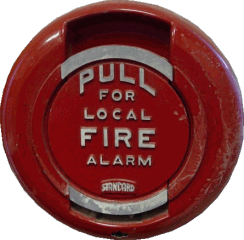
Mrs. Pearce had to prepare us for our fire safety drill. No doubt that is what the system called for. I was in grade 3 and there was a movie that we had to watch. I remember the people jumping out of burning buildings. Then we were told that we would have a fire drill. "WALK ("DON'T RUN, DON'T RUN") out of the school." It isn't a bell, the fire drill, it's a buzzing sound; a vibration that throttles in my chest.
My only recurring nightmare is of people jumping out of a burning building.
I love Mrs. Pearce. She was kind and caring and yes, very pretty. We did clay models in her class and she had us bring in a small box to store our "favourite words." Her classroom was kind, it was home. The last thing she would have wanted to do was cause any one of us anxiety, or stress or nightmares. She was told to prepare us for the fire drill and the movie came along with that preparation. She was doing her job, following the rules.
Teachers and particularly administrators, are rule followers. They are people who have succeeded in systems by doing what they say and doing it well. A Superintendent of Education didn't get there by questioning a rule.
Richard Jones, the director for assessment at EQAO, didn't arrive there by swimming against the current.
When the EQAO fry up occurred, I was in a class of ESL students and students who had failed the test in their previous attempt. There was stress in that room. At one point when we had the students try to log on for a final time, a girl in front of me looked up at me and with a great tremor in her voice cried "It's in French now!"
This was her fire drill. This may well be her recurring nightmare. I followed the rules, just like Mrs. Pearce and my rule following hurt a kid. I let the personal become the impersonal, a home become a house. All of us decided the person was not as important as the data.
In March, when EQAO asks teachers to sacrifice kids one more time for the accuracy of their data points, maybe we should break some rules.
Sunday, 16 October 2016
"Hey Teacher..."

Condom. There, I said it.
In 1987 when I started teaching religion (yes, religion), I was forbidden from uttering that word until a student mentioned it first. Yes, we were in the middle of a frightening epidemic of AIDS and yes, the single best way to prevent the spread of the disease was ....well... you know. So what was a young teacher, with fine hair, parted in the middle (stop laughing) to do? When the time came to discuss ethics and moral decision making around sex, I entered the class, wrote C-O-N-D-O-M on the board and waited for someone to read it aloud.
Teachers need to teach what their students need to know even if it runs counter to power and to culture.
As Canadians, we puzzle over how, even after the reprehensible behaviour of Trump, he manages to maintain a core support somewhere around 40% of the American population. If you haven't had a chance, check out this site Five Thirty Eight. Look at states where Donald Trump has over a 90% chance of winning. Those states are: Arkansas, Kentucky Mississippi, Louisiana, Alabama, Oklahoma, Tennessee, Wyoming, Utah, Nebraska, Idaho, West Virginia. Of those states, according to Talk Poverty , only Nebraska has a rate of higher education in the top half of the Union.
Clinton, in one of her weaker moments, called these people "deplorable" and I will forgive this categorization since she basically has had to spend countless hours with The Donald, and who after having to do that, wouldn't be a little edgy from time to time? Trump's supporters are not deplorable. They are in need of quality public education and brave teachers.
Unfortunately, some in these states and a few in our country, argue that education is a form of social engineering or perhaps in the words of Roger Watters "thought control". You remember the song: "We don't need no education, we don't need no thought control. Hey Teacher leave those kids alone. " Teachers, quite rightly, cringe at this song. Yes, the double negative is enough but no Roger, we won't leave those kids alone.
It's not thought control or left wing propaganda or political bias when you are introducing concepts such as; critical thinking, basic human rights and human dignity, equality, fairness and most importantly for our current situation, decency. How did we get to the point where teaching about these ideas can seem revolutionary and counter culture to a segment of the population? So we beat on, boats against the tide, teaching students that equity, fairness, (safe sex), kindness and human decency are essential.
We teach what our students need to know and I offer this little tip for you. The next time you hear that Pink Floyd song, insert a little Bruce Cockburn. It doesn't go with the melody but it will lift your spirits.
Hey Teacher, "kick at the darkness until it bleeds daylight."
Subscribe to:
Posts (Atom)